

Patient compliance with orthotic devices sits at around 50% across most rehabilitation settings. That number drops further when the patient never fully bought into wearing the brace in the first place. For clinicians recommending thumb support for CMC osteoarthritis or instability, that gap between prescription and consistent use is one of the most frustrating parts of the job.
The problem is rarely the brace itself. It is the conversation around it.
Patients arrive with preconceived ideas, fears, and misconceptions. They worry about looking fragile, feeling trapped, or signalling to colleagues and family that something is seriously wrong. Without a clear framework for addressing those concerns, even the most appropriate orthosis ends up sitting in a drawer.
This guide is for physical therapists and occupational therapists who want to close that gap. It covers the most common objections you will hear, practical scripted responses you can adapt, and patient education strategies that build genuine long-term compliance.
Why Patients Resist Bracing (And Why Logic Alone Does Not Fix It)
Before you can address objections effectively, it helps to understand where they come from. Resistance to bracing is rarely about the device itself. It is almost always about identity, perception, and fear.
Research in health psychology consistently shows that patients are more likely to comply with treatment recommendations when they feel the intervention aligns with their self-image and daily life. A brace that a patient sees as a sign of weakness or permanent decline will be removed the moment they leave your clinic, regardless of how well it fits.
Three core resistance patterns show up repeatedly:
- Appearance and social stigma. Patients do not want to look injured, elderly, or limited. This is especially common among working adults and anyone who is active in sport or fitness.
- Discomfort and inconvenience. First impressions matter. If the initial fit is uncomfortable or the brace feels cumbersome, patients anchor to that experience and rarely revisit it.
- The “weakness” narrative. Many patients interpret wearing a brace as giving in to an injury rather than managing it proactively. This is deeply tied to how they see themselves.
Each of these requires a different response. Treating them all the same is where many clinicians lose the conversation.
Reframing the Brace as a Tool, Not a Crutch
The single most effective shift you can make is changing how you introduce the device. Most clinicians present a brace in terms of what it prevents. Flip that entirely and present it in terms of what it enables.
Instead of: “This will protect your joint from further damage.”
Try: “This gives your thumb the support it needs to keep doing the things you want to do, without paying for it later in the day.”
The word “protection” is passive. It implies vulnerability. Framing the brace as something that extends capacity and maintains function lands very differently with patients who see themselves as capable and active.
For patients managing CMC osteoarthritis specifically, this framing is clinically accurate. A well-fitted thumb CMC brace supports the joint during pinch and grip activities without eliminating movement, which means patients can continue cooking, writing, gardening, or working with far less pain. That is not dependency. That is smart management.
Scripted Responses to the Most Common Objections
“I don’t want to look like I’m wearing a medical device all day.”
Acknowledge it directly. Patients respect honesty far more than dismissal.
“That’s a fair concern, and you’re not the first person to raise it. A lot of people feel exactly the same way. The good news is that modern thumb braces are designed to be low-profile and worn under or alongside everyday clothing. Most people around you won’t notice it at all, and after a week or two, you often stop noticing it yourself.”
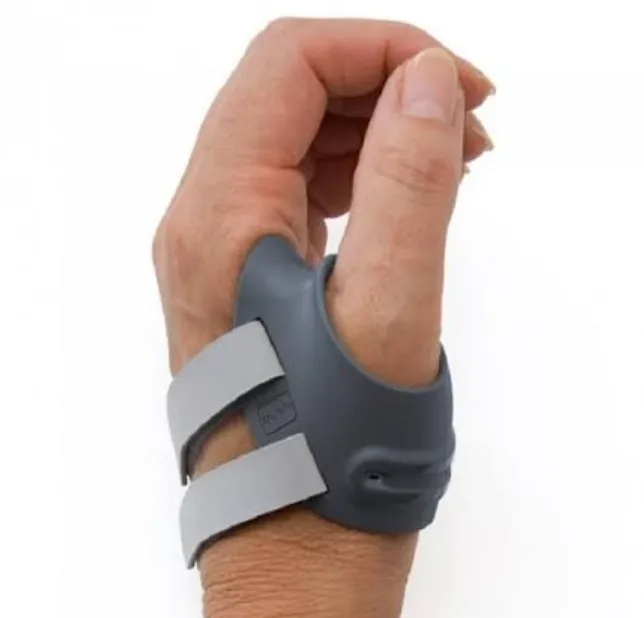
If you are working with a patient using the MetaGrip thumb brace, this conversation gets easier. The CMC brace design sits close to the thenar eminence, avoids covering the wrist entirely, and allows a near-full range of finger movement, which means it is far less conspicuous than older, bulkier orthotics.
“It feels tight and uncomfortable when I wear it.”
This one almost always comes from either an improper fit or insufficient acclimatisation time.
“Initial tightness is really common, and it doesn’t mean the brace is wrong for you. Your hand needs a few days to adjust. Let’s look at the fit together right now and make sure it’s sitting correctly, because small adjustments at this stage make a big difference to how it feels in week two.”
Then take the time to do exactly that. Fit issues are responsible for a significant proportion of early abandonment. Thirty minutes spent on fit and patient education at the point of prescription saves far more time than managing a non-compliant patient six weeks later.
“I feel like I’m giving up. I should be able to manage this on my own.”
This is the hardest one because it is rooted in values, not just preference.
“I hear that, and it tells me a lot about how you approach challenges. The thing is, using a brace isn’t giving up. It is the same logic as wearing the right footwear for a long run. You wouldn’t call that weakness. This is a tool that lets your joint recover and function at the same time. Most people who resist it early on become the biggest advocates for it once they feel the difference.”
If it helps, share a brief normalising example. Something like: “I see a lot of patients in physically demanding jobs, people who work with their hands all day, and many of them use a thumb brace just to get through their shift comfortably. It has nothing to do with giving in.”
Building a Patient Education Strategy That Actually Sticks
Scripts are a starting point, not an end point. Long-term compliance is built through consistent, layered education rather than a single conversation.
Use a Three-Stage Education Model
Stage 1: Explain the why before the what. Before introducing the brace, make sure the patient genuinely understands their condition. What is happening at the CMC joint? Why does that cause pain during grip? How does compression and stabilisation reduce that pain? Patients who understand their anatomy are significantly more motivated to manage it.
Stage 2: Demonstrate, then involve. Show the patient how to put the brace on and take it off. Then watch them do it. This sounds basic but is often skipped. Independence with the device is one of the strongest predictors of consistent use.
Stage 3: Set realistic expectations with a short trial commitment. Ask the patient to commit to wearing the brace for just five days. Not forever. Just five days. Then review together. This removes the psychological weight of a permanent commitment and gives you a structured check-in to reinforce the benefits they have already felt.
Give Patients a Reference Point
Many patients do not know what good compliance looks like. Provide a simple wearing schedule tailored to their activity level and pain pattern. For example, someone working at a desk with frequent typing might wear the brace during work hours initially, then extend based on comfort. Someone doing manual work might need support during specific tasks only.
For clinicians looking to deepen their knowledge of thumb CMC orthoses and the clinical evidence behind them, BraceLab offers a range of resources alongside product information that many therapists find useful when educating patients and building care plans.
When to Revisit the Conversation
Not every patient will come around in the first appointment. Some need time, and that is fine. What matters is that you build in structured checkpoints rather than leaving the conversation open-ended.
At the two-week mark, ask specifically:
- How many days did you wear it this week?
- What tasks did you wear it for?
- Were there situations where you chose not to wear it? Why?
These questions surface real-world barriers that the initial conversation never could. From here, you can troubleshoot specifically. Whether it is fit, self-consciousness in a particular social setting, or difficulty with donning, each has a targeted response that improves the picture.
Compliance is not a one-time conversation. It is an ongoing clinical relationship.
Key Takeaways
- Patient resistance to bracing is almost always rooted in identity and perception, not logic, and requires a values-aware response rather than a purely clinical one.
- Framing a brace as something that enables rather than prevents will resonate more deeply with active, independent-minded patients.
- Address the three core objections (appearance, discomfort, perceived weakness) with separate, specific scripted responses rather than a general defence of the device.
- Fit, education, and acclimatisation are the three biggest drivers of early abandonment. Address all three at the point of prescription.
- A short trial commitment of five days is far more effective than asking for open-ended compliance. Follow up with specific questions at two weeks.
Frequently Asked Questions
How do I handle a patient who has tried a thumb brace before and had a bad experience? Start by asking what specifically felt wrong, whether it was fit, comfort, design, or something else. Previous bad experiences are almost always product-specific or fit-related rather than a blanket response to bracing. Validating that their experience was real, and then differentiating the current recommendation from what they tried before, gives you a clean slate.
At what stage of CMC osteoarthritis is a thumb brace most appropriate? Thumb CMC bracing is widely used across stages one through three, where pain management and functional support are the primary goals. In later stages, the clinical picture becomes more complex and surgical options may enter the conversation. For mild to moderate cases, a well-designed CMC orthosis remains one of the most evidence-supported conservative interventions available.
Should I recommend full-time wear or activity-specific wear for thumb bracing? This depends on symptom severity and the patient’s activity demands. Patients with constant pain often benefit from full-time wear initially, tapering as inflammation settles. For patients with activity-specific pain during grip or pinch, targeted wear is often better for compliance without significantly compromising outcomes.
What if a patient removes the brace at work because of colleagues’ reactions? This is a real barrier that often goes unaddressed. Helping the patient prepare a brief, confident explanation for colleagues (“It’s just for a joint issue, I can still do everything I need to do”) reduces the social friction significantly. Some patients also find that wearing the brace consistently actually opens up positive conversations rather than negative ones.
How do I know if a patient’s ongoing discomfort is a fit issue or a device issue? If discomfort is localised to a pressure point or skin irritation, it is almost always a fit adjustment. If the patient reports general heaviness, heat, or restriction that does not improve after the first week with good adherence, it is worth reviewing whether the design is appropriate for their anatomy and functional requirements.
Conclusion
Skepticism about bracing is not a clinical failure. It is a normal human response to something unfamiliar that challenges how a person sees themselves. The therapists who get the best compliance outcomes are not the ones with the most clinical knowledge, though that clearly matters. They are the ones who treat the conversation around a brace with the same care they bring to every other part of the rehabilitation process.
The frameworks here are a starting point. Adapt the language to your patients, your setting, and your style. The core principle stays the same: meet patients where they are, explain what the device actually does for their life, and build the relationship over time rather than expecting a single conversation to do all the work.
That approach, applied consistently, is what turns a brace in a drawer into a brace that actually helps someone.

Alan Abel is a naming specialist and author at BoldlyNames, with over five years of experience in name research and selection. He helps readers choose meaningful, culturally aware, and well-suited names for people, brands, and projects. Alan’s work combines practical insight, linguistic understanding, and real-world naming trends to deliver clear, reliable guidance readers can trust.