

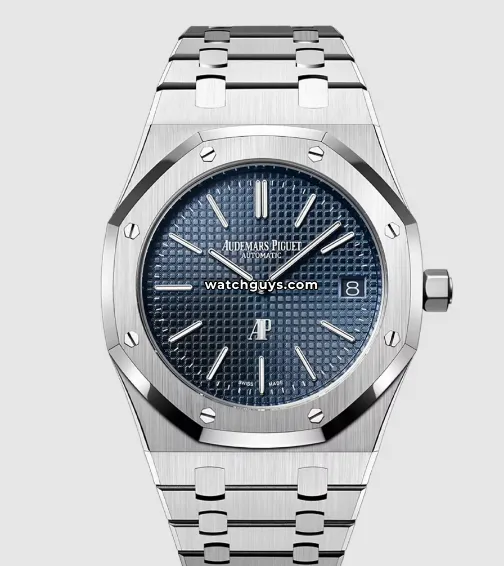
The Audemars Piguet Royal Oak turned the watch industry upside down in 1972. A steel sports watch priced higher than gold dress watches was not supposed to work. It did. Fifty-plus years later, the Royal Oak is one of the most collected, traded, and debated references in the entire secondary market, and the range has expanded so significantly that “I want a Royal Oak” is no longer a simple statement. It is the beginning of a much longer conversation.
This guide is designed to move you through that conversation efficiently, covering the references that matter most, the generational shifts that affect value and wearability, and the collecting logic behind each category.
The 15202 Jumbo: The Original, and Still the Standard
When collectors say “the Jumbo,” they mean the direct descendant of Gerald Genta’s original 1972 design. The current expression is the 15202, a 39mm piece running the ultra-thin Calibre 2121, with that signature blue or white Grande Tapisserie dial and no date window. That missing date is a deliberate design choice, and for purists it is everything.
The 15202 is thinner, cleaner, and architecturally closer to the original than anything else in the current lineup. It sits beautifully on a range of wrist sizes and wears with a formality the larger modern references cannot quite match.
From a collecting standpoint, it is also the more illiquid piece. Production volumes are limited, and demand from serious collectors means examples rarely stay available for long. Pricing reflects that scarcity, and values have held with notable consistency even during broader market corrections.
Who the 15202 is right for:
- Collectors prioritising historical integrity and design purity
- Buyers who prefer a slimmer, more formal sports watch
- Anyone building a long-term collection where a single definitive Royal Oak makes sense
The 15500: Modern Calibre, Polarising Redesign
Released in 2022, the 15500 replaced the long-running 15400 as the date model in the core lineup. It moved to the in-house Calibre 4302, bringing a faster beat rate and improved accuracy, but the more visible change was the dial. The indices are slightly thicker, the overall finish is crisper, and to some eyes the character is subtly different from what came before.
That redesign split the collector community. Some welcomed the refinement. Others felt the 15400 had a more balanced proportion, and the secondary market for good condition 15400 examples stayed surprisingly active after the transition.
The 15500 is the more practical daily wear choice for most buyers. It is a 41mm watch with contemporary finishing standards, a case size that suits modern wrist preferences, and a movement that will be well-supported for decades. New retail allocation is famously restricted through authorised dealers, so the secondary market is the primary access point for most buyers, regardless of their relationship with an AD.
Where the 15500 makes sense:
- First-time Royal Oak buyers who want a daily wear reference with current production support
- Collectors who value movement quality and finishing over vintage character
- Buyers comparing the 15500 directly against the 15400 should examine both dials in person before deciding
Steel Versus Precious Metal: A Collecting Decision, Not Just a Budget Decision
This is where a lot of buyers trip themselves up. The instinct is to treat steel as the “entry” category and gold or platinum as the aspirational tier. That framing misses how the Royal Oak actually works as a collectible.
The steel Royal Oak is, counterintuitively, the more desirable reference in most collecting contexts. It is what the watch was designed to be. The combination of brushed and polished surfaces on steel is harder to execute and more distinctive than the same finishing on gold. Pricing for steel references is higher than many gold examples of the same model, and that has been true for years.
That said, precious metal Royal Oaks have their own appeal, particularly in yellow gold, which creates a very different visual character. Certain reference-specific releases in rose or white gold have developed strong followings among collectors interested in rarer dial and case combinations. The platinum Jumbo, produced in very limited numbers, is a trophy piece for serious collectors.
The practical advice here is to buy the material that suits your intended use. Steel for daily wear, where durability and versatility matter. Precious metal if you are drawn to a specific reference where the alloy is integral to the design, rather than simply an upgrade.
Early Hollowback Examples: Vintage Territory With Real Complexity
The earliest Royal Oaks from the 1970s and into the 1980s are identifiable by their open caseback, sometimes called a “Hollowback,” which shows the movement through a simple opening rather than a display crystal. These pieces represent the original Genta vision and carry the history of the reference in a tangible way.
Collecting early Royal Oaks is genuinely specialist territory. Dial condition, especially the integrity of the Tapisserie pattern, is paramount. Original bracelets matter enormously, and the clasp, end links, and bracelet taper all feed into value. Service history and originality of components carry weight in a way that differs from modern references.
Buyers approaching this category for the first time should do their research carefully. The vintage Royal Oak market rewards deep knowledge, and the gap between a well-preserved example and a tired one is reflected dramatically in price. Resources like Bob’s Watches or authoritative auction records from Christie’s and Phillips can provide useful reference points for condition benchmarking.
The Royal Oak Offshore: A Separate Collecting Category
The Offshore arrived in 1993, designed by Emmanuel Gueit, and it was deliberately confrontational. Bigger, bolder, and more aggressive than the original, it was initially derided by some of the watch press as “the Beast.” That nickname stuck, and the Offshore found its audience.
Today, the Offshore is best understood as a parallel collecting universe within the Royal Oak family. It shares the octagonal bezel DNA but diverges significantly in character, case size and complication range. Reference-specific Offshore models, particularly limited editions and the early 25721ST references, attract dedicated collectors who are largely independent from the Jumbo crowd.
Key distinctions for buyers:
- The 26400: The current core Offshore, running at 44mm with a robust movement and genuine sports watch credentials
- Chronograph Offshores: A deep category with multiple generations of calibres and significant variation in dial and strap configurations
- Limited editions and celebrity collaborations: Some of the most liquid and culture-adjacent pieces in the entire AP catalogue, with pricing that can be volatile
If your collecting instinct runs toward maximum presence on the wrist and a design that leans into sport rather than elegance, the Offshore is a legitimate and rewarding category. Just approach it as its own subject rather than an extension of the Jumbo conversation.
How This Connects to Your Broader Collection Strategy
The Royal Oak rarely exists in isolation for serious collectors. It sits alongside other modern or vintage Swiss pieces, and the question of which reference to acquire is partly about what you already own and where you want to go next.
Collectors who come to the Royal Oak from a Patek Philippe background, for instance, often gravitate toward the Jumbo for its shared appreciation of ultra-thin movements and restrained design language. If you are actively building across Swiss sport-luxury references and want to explore available inventory or source a specific piece, Wrist Aficionado maintains a curated selection across both AP and other major houses, with authentication on every piece in stock.
For those who want to compare Royal Oak values against the broader pre-owned market, looking at how equivalent references within Patek Philippe track over time is genuinely instructive. The way the Nautilus and Jumbo move relative to one another tells you a great deal about how the market weights design legacy versus production volume. Browsing the Patek Philippe collection alongside AP references gives you a practical sense of where each sits on the value and desirability curve.
Key Takeaways
- The 15202 Jumbo is the purist’s choice, with limited production and strong value retention, but it commands a premium over the 15500 for that privilege
- The 15500 is the more practical daily reference, with modern movement specifications and broader availability on the secondary market
- Steel Royal Oaks are not the “base” tier; in most cases they are the more collectible and more expensive versions
- Early Hollowback examples require specialist knowledge to buy well; do not enter that market without understanding dial and bracelet originality
- The Offshore is its own collecting category, not simply a larger Royal Oak, and should be evaluated on those terms
FAQ
Is the Royal Oak 15202 worth the premium over the 15500? For collectors who prioritise design purity and historical connection to the original 1972 reference, yes. The 15202 runs the same ultra-thin Calibre 2121 that has been in continuous production since the 1970s, wears slimmer on the wrist, and lacks a date window, which many consider a cleaner look. The premium reflects scarcity as much as anything else; the 15202 is significantly harder to find in the secondary market.
Should I buy a Royal Oak in steel or gold? That depends on how you intend to wear it and what draws you to the reference. Steel is the historically correct material for the Royal Oak and commands higher secondary market prices in most configurations. Gold makes sense if you are drawn to a specific dial or limited reference where the precious metal is part of the design concept rather than simply a material upgrade.
What should I look for when buying a vintage Royal Oak? Focus on dial condition above everything else. The Tapisserie pattern shows wear, fading, and previous polishing in ways that affect value significantly. Original bracelet components, particularly the end links and clasp, also matter. If the watch has been serviced, verify that the dial and hands are original rather than replaced during a service.
Is the Royal Oak Offshore a good long-term collectible? Certain references, particularly early production Offshores and limited editions with documented cultural significance, have performed well as long-term holdings. The broader Offshore market is more volatile than the core Royal Oak lineup, so buyers should focus on specific references with clear collector demand rather than treating the category as uniformly stable.
How does the Royal Oak compare to a Patek Philippe Nautilus as a collecting asset? Both are benchmark references in the sport-luxury category and both have experienced significant appreciation over the past decade. The Nautilus tends to attract buyers who lean toward refinement and technical sophistication in movement finishing. The Royal Oak, particularly the Jumbo, appeals to collectors drawn to the design’s architectural boldness. Performance over time has been broadly similar for the most desirable references in each family, though exact movements in pricing depend heavily on specific models and condition.
Conclusion
The Royal Oak is one of those watches where the more you learn, the better your decisions get. The difference between buying the right reference for your goals and buying the wrong one is not just about money. It is about living with a watch that genuinely suits how you collect and wear.
Take the time to understand what each generation and configuration actually represents before committing. Handle examples where possible, compare dial generations side by side, and think about where a Royal Oak fits within your broader collection rather than treating it as a standalone acquisition.
The secondary market for these watches is active and deep, and the right piece is out there. The goal is simply to be informed enough to recognise it when you see it.

Alan Abel is a naming specialist and author at BoldlyNames, with over five years of experience in name research and selection. He helps readers choose meaningful, culturally aware, and well-suited names for people, brands, and projects. Alan’s work combines practical insight, linguistic understanding, and real-world naming trends to deliver clear, reliable guidance readers can trust.