

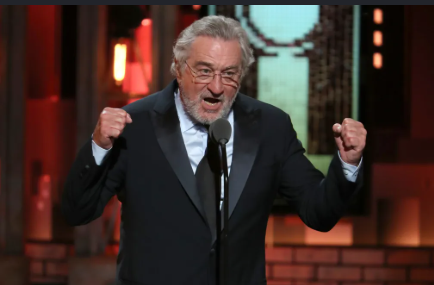
Robert De Niro built his career on discipline. Directors, actors, and film historians often cite his preparation for roles as a model of method acting. Early performances in films like Taxi Driver, Raging Bull, and The Godfather Part II established him as an actor willing to reshape his body, voice, and habits for a character. Audiences watched him gain significant weight for a boxing drama, learn Sicilian dialects, and even drive taxis in New York to understand the routines of a lonely cab driver. That dedication created an image of seriousness and artistic commitment.
For decades De Niro maintained a quiet public persona. He rarely gave lengthy interviews and seldom appeared in tabloids. Many actors build their fame partly through publicity, but De Niro seemed content to let his work speak. The strategy worked. Critics often placed him among the greatest actors of his generation.
As the years passed, however, the distance between the artist and the public figure narrowed. The same actor who once avoided public debate began speaking loudly about political issues. The shift surprised many viewers who remembered the reserved performer of earlier decades. His comments, delivered in blunt language and often during high-profile events, turned him from a quiet craftsman into one of Hollywood’s most outspoken voices.
That change created admiration in some circles and irritation in others. Fans who shared his political views praised his willingness to speak without hesitation. Critics argued that a celebrated actor had stepped into a role that resembled a campaign speaker rather than an entertainer. The result was a reputation that now includes both artistic respect and persistent controversy.
The Moment an Actor Entered Political Debate
De Niro’s political statements grew more visible during the mid-2010s. Television interviews, film festivals, and awards ceremonies gave him opportunities to express strong opinions about American leadership and policy. His words often carried the same intensity he brought to film roles. He rarely softened criticism or diluted a statement for diplomatic reasons.
During several public appearances he used direct language that immediately circulated through news broadcasts and social media. Supporters described those moments as refreshing honesty. They saw a prominent artist speaking without the cautious phrasing that politicians usually employ. Critics, however, viewed the comments as theatrical political messaging.
Political analysts frequently note that celebrity involvement in politics is not new. Actors such as Ronald Reagan and Arnold Schwarzenegger eventually ran for office. Musicians and filmmakers have long supported causes or candidates. De Niro’s case stands out because he never sought elected office yet delivered speeches that sounded like campaign rhetoric.
The effect became clear during election seasons. Television networks replayed clips of his remarks, commentators debated them, and political campaigns sometimes referenced them. An actor known for playing intense characters had become a recurring figure in political news cycles.
Some observers welcomed the transformation. They argued that public figures with large audiences can raise awareness about issues that might otherwise remain confined to policy circles. Others saw a different pattern. They believed that celebrity voices often simplify complicated debates while receiving disproportionate attention.
The tension between those viewpoints continues today. De Niro’s political presence remains strong, and his speeches often trigger immediate reactions across ideological lines.
Business Interests Behind the Public Persona
While political statements draw attention, De Niro also operates as a businessman. His ventures extend far beyond film contracts. Restaurants, hotels, and film festivals form a significant part of his professional life. These enterprises connect him to international tourism and luxury hospitality.
One of his most visible ventures is the Nobu brand. The partnership between De Niro, chef Nobu Matsuhisa, and producer Meir Teper expanded from a single restaurant into a global network of restaurants and hotels. The brand operates in cities across Asia, Europe, and the Americas. Each location emphasizes Japanese-inspired cuisine combined with high-end design.
Such ventures attract praise for their culinary influence and economic success. They also invite scrutiny. Critics sometimes question whether wealthy celebrities who criticize political systems benefit from those same systems through international business structures. De Niro’s critics occasionally raise that argument when discussing his outspoken public comments.
Supporters respond with a simple counterpoint. They note that entrepreneurship does not cancel a person’s right to express political opinions. In their view, building businesses and speaking about politics are separate activities. They also point out that the hospitality sector creates jobs and supports local economies.
Business ventures inevitably place public figures under financial microscopes. Investors, journalists, and political commentators examine partnerships, corporate structures, and tax arrangements. De Niro’s involvement in international hospitality has therefore become another layer of his public narrative.
Visitors to one of the Nobu restaurants might focus only on food and atmosphere. Some sit for hours discussing films or business deals while servers move between polished tables and softly lit restaurant booths. Few guests consider that the owner behind the brand also stands at the center of political arguments that dominate television debates.
Legal Battles and Workplace Disputes
Public lawsuits often reshape how audiences view celebrities. De Niro faced one of the most widely discussed disputes when a former employee filed a lawsuit connected to workplace treatment and compensation issues. The case attracted intense media attention because it involved personal accusations, employment claims, and counterclaims from De Niro’s company.
Legal filings described disagreements over duties, communication style, and professional boundaries. The dispute became complicated as both sides accused the other of misconduct. Court hearings revealed private messages, internal office dynamics, and descriptions of working conditions inside the company.
Media coverage focused heavily on power dynamics between famous employers and staff members. Commentators debated whether the situation reflected broader problems in entertainment and corporate environments. Supporters of the employee emphasized the vulnerability of assistants working for powerful figures. Defenders of De Niro pointed out inconsistencies in claims and emphasized the complexity of the legal arguments.
Lawsuits involving celebrities rarely remain quiet legal matters. Television commentators dissect testimony, newspapers summarize courtroom exchanges, and online discussions often transform partial information into definitive judgments. Even when courts reach decisions based on evidence and law, public opinion often forms earlier and changes slowly.
The dispute surrounding De Niro demonstrated how quickly professional disagreements can become global headlines. For an actor who once avoided publicity, the case placed him under an uncomfortable spotlight that had little to do with film.
Media Reactions and the Price of Blunt Speech
Public speech carries consequences when delivered by famous figures. De Niro’s comments frequently travel beyond the original setting. A remark made during an interview may appear hours later on political blogs, talk shows, and international news programs.
The tone of his statements often drives the reaction. De Niro rarely relies on cautious phrasing. His words tend to be direct and emotionally charged. That style attracts attention because it contrasts with the carefully measured language used by many public relations teams.
Media responses vary widely. Some journalists frame his remarks as examples of artistic courage. They argue that actors and musicians can use cultural influence to highlight political concerns. Others interpret the same statements as performative outrage. Those critics suggest that celebrities sometimes speak in dramatic language to maintain visibility rather than to contribute detailed policy analysis.
Social media intensifies the cycle. Short video clips travel quickly through digital networks. Supporters share them with enthusiastic commentary. Opponents repost them with criticism or satire. The result is a constant loop of reaction that keeps the original statement alive long after the event.
The phenomenon illustrates a broader change in public communication. Famous individuals no longer speak only through carefully edited interviews or magazine profiles. A single speech delivered on stage can reach millions of viewers within minutes.
For De Niro, that reality means every strong comment becomes a potential headline. The actor who once spoke rarely now faces continuous analysis whenever he addresses political subjects.
Celebrity Activism and the Charge of Hypocrisy
The debate surrounding De Niro reflects a larger cultural question. Should celebrities participate in political debates with the same intensity as activists or elected officials? Opinions on the subject remain deeply divided.
Supporters of celebrity activism argue that artists often hold unique perspectives shaped by travel, cultural collaboration, and exposure to social issues. Film actors, musicians, and writers frequently encounter communities across different countries and economic conditions. Those experiences can motivate them to speak publicly about inequality, civil rights, or political leadership.
Critics view the situation differently. They argue that fame provides a powerful platform without requiring the same accountability expected from politicians or policy experts. A famous actor can deliver a speech that influences millions of viewers without presenting detailed policy proposals or facing electoral consequences.
De Niro often becomes a central example in this debate because his statements combine strong language with a refusal to soften criticism. Commentators sometimes describe him as behaving like a “cheap politician,” meaning a public figure who delivers fiery speeches but never enters the electoral arena where compromise and negotiation are unavoidable.
Supporters reject that label. They emphasize that citizenship includes the right to speak passionately about political issues. They also note that artists have historically shaped political discussion through novels, theater, and cinema.
The disagreement shows no sign of disappearing. As long as celebrities command global attention, their voices will remain part of political conversations whether critics welcome it or not.
An Actor’s Legacy Under Continuous Examination
Robert De Niro’s career spans more than five decades. Few actors maintain such longevity while continuing to appear in major films and cultural discussions. His performances influenced generations of filmmakers and actors who study his dedication to character development.
Yet modern reputations rarely depend on artistic achievements alone. Public figures now operate within an environment where business decisions, political statements, and legal disputes receive the same scrutiny as creative work. De Niro’s life illustrates how quickly a celebrated career can intersect with controversy.
Film historians often separate the actor’s craft from his public commentary. They analyze his collaborations with directors such as Martin Scorsese and examine how those films reshaped American cinema. Students of acting continue to watch his performances as examples of emotional intensity and transformation.
At the same time, journalists and commentators examine his political speeches, lawsuits, and business ventures. Those elements form a second narrative that runs parallel to the story of artistic achievement.
Some audiences prefer to focus exclusively on the films. Others view the entire public record as inseparable from the art. The disagreement reflects a larger cultural shift. In an era of constant media coverage, separating creative work from personal conduct becomes increasingly difficult.
De Niro remains active both on screen and in public debate. Each new film or interview adds another chapter to a complicated reputation. Admirers praise his honesty and passion. Critics question the tone and timing of his political interventions.
The actor who once guarded his privacy now occupies a role that resembles a permanent public commentator. Whether that transformation strengthens or complicates his legacy depends largely on the observer’s perspective.
What remains undeniable is the scale of his influence. Few performers achieve such cultural reach while simultaneously provoking political discussion across continents. Robert De Niro’s career therefore stands as both a cinematic triumph and a case study in how fame, politics, and public opinion intersect in modern culture.

Alan Abel is a naming specialist and author at BoldlyNames, with over five years of experience in name research and selection. He helps readers choose meaningful, culturally aware, and well-suited names for people, brands, and projects. Alan’s work combines practical insight, linguistic understanding, and real-world naming trends to deliver clear, reliable guidance readers can trust.